
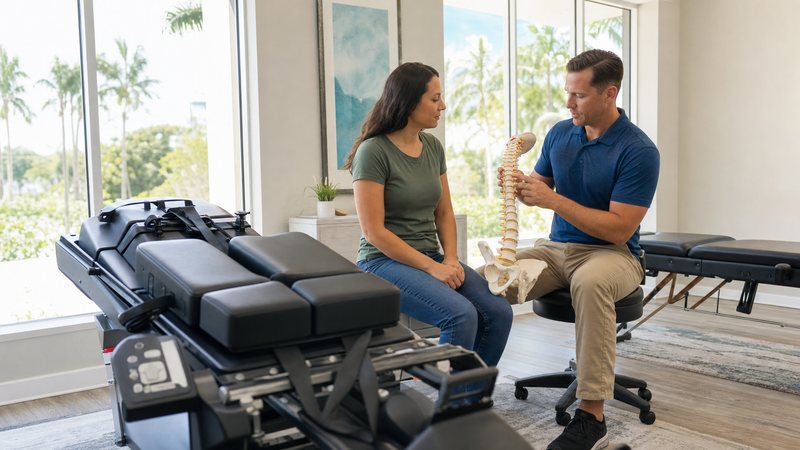
Disc pain can feel like pressure, sharp lower back pain, sciatica, numbness, or pain that travels into a leg. Two common conservative options are spinal decompression and chiropractic care. They overlap, but they do different jobs.
Short answer
Spinal decompression is designed to reduce pressure on irritated discs and nerves through controlled traction. Chiropractic care is designed to improve spinal motion, alignment, and nervous system function. For some disc-related cases, the right plan may use both.
If pain travels into a leg, gets worse with coughing or sitting, includes numbness or weakness, or has not improved with basic care, the first step is not guessing between services. The first step is an exam that checks whether the symptoms actually point to a disc or nerve-pressure problem.
Comparison table
| Question | Spinal decompression | Chiropractic care |
|---|---|---|
| Primary target | Disc pressure and nerve irritation | Joint motion, alignment, posture, and function |
| Common fit | Herniated discs, bulging discs, sciatica, some stenosis-related symptoms | Back pain, neck pain, headaches, posture, mobility, recurring mechanical stress |
| How it feels | Gentle traction on a decompression table | Manual, table-assisted, or instrument-assisted adjustment |
| Plan style | Usually a series of decompression visits over several weeks | Relief-focused or corrective care plan depending on findings |
| Key question | Is disc pressure part of the symptom pattern? | Is spinal mechanics part of the recurring stress? |
Who spinal decompression may help
Spinal decompression may fit people with disc-related pain, leg symptoms, sciatica, numbness, or nerve pressure. It is especially relevant when imaging or exam findings suggest disc compression is part of the problem. It is not usually the first choice for simple muscle soreness or pain that is clearly unrelated to disc pressure.
Who chiropractic care may help
Chiropractic care may fit people with restricted spinal movement, posture changes, recurring back or neck pain, headaches, or nervous system irritation. Corrective care looks at why the area became stressed in the first place, which matters when disc symptoms are part of a larger alignment or movement pattern.
When both may be used
When disc pressure and spinal mechanics are both involved, decompression may help reduce pressure while chiropractic care addresses motion and structural stress. For example, a patient with sciatica from disc irritation may also have pelvic or lumbar mechanics that keep loading the same disc. The exam determines whether that combination makes sense.
"The goal is not to pick a tool first," says Dr. Austin Elkin. "The goal is to understand the pattern, then choose the care that matches the findings."
When another path may be needed
Progressive weakness, loss of bowel or bladder control, fever, unexplained weight loss, recent major trauma, cancer history, or severe unrelenting pain should be medically evaluated. Decompression and chiropractic care are conservative options, not substitutes for urgent medical care when red flags are present.
Cost and timeline questions
Before starting decompression, ask how many visits are expected, how progress will be measured, whether imaging is needed, what the total plan costs, and what would cause the plan to change. Most decompression plans are built as a series because disc pressure usually does not change from one visit.
Fort Myers decompression care
City of Palms Chiropractic offers spinal decompression in Fort Myers as part of a conservative care approach for selected disc-related symptoms. People comparing options can also read our herniated disc vs bulging disc guide or call (239) 690-7794 to ask whether a free consultation makes sense.
Frequently Asked Questions
Does decompression hurt?
Most people describe decompression as gentle stretching. If symptoms increase, the plan should be reassessed.
Do I need an MRI before decompression?
Not always. Existing imaging can be helpful, but the need for imaging depends on your history, exam findings, and symptom pattern.
Can decompression replace surgery?
Sometimes conservative care is appropriate before surgery, but not always. Surgical decisions should stay coordinated with the appropriate medical provider when severe or progressive symptoms are present.