

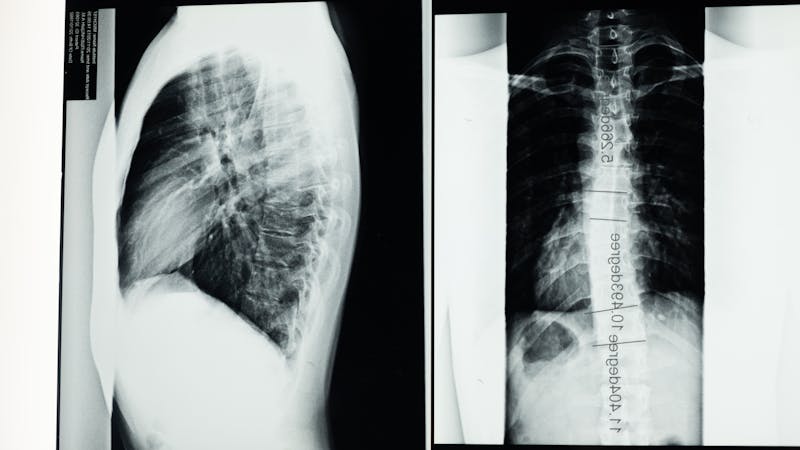
Spinal X-rays in corrective chiropractic care serve as the blueprint for your entire treatment plan. They reveal the exact angles, curves, and positions of each vertebra so your chiropractor can measure what is wrong, design a specific correction strategy, and track whether your spine is actually changing over time. Without this imaging, corrective care becomes guesswork. With it, every adjustment and traction session has a measurable target.
Why Do Corrective Chiropractors Rely on Spinal X-Rays?
Physical exams tell your chiropractor a lot. Palpation reveals joint restrictions. Posture analysis shows visible asymmetry. Range of motion testing identifies functional limitations. But none of these methods can tell you whether a cervical curve measures 12 degrees when it should measure 35, or whether a lumbar vertebra has shifted 8 millimeters to the left. That information lives inside the X-ray.
Corrective chiropractic care is built on the principle that spinal structure determines spinal function. If the structure is wrong, function suffers. X-rays are the only practical way to see that structure in a living patient. A 2005 study published in the Journal of Manipulative and Physiological Therapeutics found that chiropractic X-ray analysis had high inter-examiner reliability, meaning different doctors measuring the same X-ray reach the same conclusions (JMPT, 2005). This makes X-ray-based care both reproducible and accountable.
For a closer look at what these images can reveal, read our earlier post on what a chiropractic X-ray shows.
What Do Chiropractors Measure on Spinal X-Rays?
When your chiropractor takes standing X-rays and loads them into analysis software, they are looking at specific structural markers. Here are the most common measurements:
- Cervical lordosis (C2-C7 Cobb angle): The curve of the neck should measure between 31 and 40 degrees. A reduced or reversed curve indicates loss of cervical lordosis, which is strongly linked to neck pain and headaches.
- Thoracic kyphosis (T1-T12 Cobb angle): The upper back curve normally ranges from 20 to 45 degrees. Excessive kyphosis shows as a rounded or hunched upper back.
- Lumbar lordosis (L1-L5 Cobb angle): The lower back curve should measure between 40 and 60 degrees. Too much or too little predicts chronic lower back pain.
- Vertebral translation: Whether individual vertebrae have slid forward, backward, or sideways from their ideal position, measured in millimeters.
- Disc height: Thinning discs indicate degeneration and uneven loading that corrective care can slow or reverse.
- Scoliotic curves: Lateral deviation of the spine measured with the Cobb angle from the front-view (AP) X-ray.
- Head position: Anterior head translation (how far the head sits in front of the shoulders) measured in millimeters from the lateral view.
These numbers become your baseline. Every decision in your care plan traces back to them.
How Do X-Rays Shape Your Treatment Plan?
Once measurements are complete, your chiropractor translates the numbers into a specific protocol. This is where corrective care separates itself from standard chiropractic treatment. Nothing is generic. Every element of the plan targets a measured deficit.
Adjustments are direction-specific. If your C5 vertebra has shifted 4 millimeters posteriorly and rotated 6 degrees to the right, the adjustment targets that exact segment in the exact opposite direction. The X-ray tells your chiropractor which way to push, how much force to use, and at what angle.
Traction is set to your curve deficit. If your cervical lordosis measures 15 degrees when normal is 35, the traction device is configured to apply a corrective force toward that 35-degree target. The setup is not the same for everyone. Your curve number determines the position, angle, and duration of traction.
Exercises match your weak points. A patient with forward head posture and reduced cervical lordosis gets different exercises than a patient with excessive lumbar lordosis and anterior pelvic tilt. X-ray findings dictate which muscles need strengthening and which need stretching.
"I never start treatment without X-rays," says Dr. Austin Elkin, Doctor of Chiropractic at City of Palms Chiropractic in Fort Myers. "Adjusting a spine without imaging is like a pilot flying without instruments. You might get lucky, but you have no way to know if you are heading in the right direction."
What Happens During Your First X-Ray Visit?
Your initial visit at a corrective care office typically follows a structured process:
Step 1: Health history review. You fill out a detailed questionnaire covering your symptoms, injury history, past treatments, medications, and health goals. The chiropractor reviews this with you before any imaging.
Step 2: Physical examination. This includes posture analysis (often photographed from multiple angles), range of motion testing, orthopedic and neurological screening, and palpation of the spine. These findings help the chiropractor decide which X-ray views are needed.
Step 3: X-ray imaging. Standing X-rays are taken in two primary views: lateral (side) and anteroposterior (front). Some patients also need oblique views, stress views, or full-spine images depending on their presentation. The images are captured digitally and available for analysis within minutes.
Step 4: Report of findings. On your second visit (usually 1 to 3 days later), the chiropractor walks you through your X-rays on screen. You see exactly where your spine deviates from normal. Measurements are explained in plain language, and the recommended care plan is presented with specific goals, timeline, and visit frequency.
View our full range of diagnostic and treatment options on our services page.
How Do Progress X-Rays Track Real Improvement?
Progress X-rays are one of the most powerful aspects of corrective chiropractic care. They answer the question that every patient asks: is this working?
Most protocols call for follow-up imaging every 30 to 90 visits, depending on the condition being treated. According to a 2019 study published in the Journal of Physical Therapy Science, patients who underwent CBP corrective care and were tracked with serial X-rays showed an average improvement of 12.4 degrees in cervical lordosis over a 12-week period (Journal of Physical Therapy Science, 2019). That kind of change is visible on the X-ray even to an untrained eye.
Progress X-rays serve several purposes:
- Confirm the spine is moving in the right direction. If measurements improve, the plan is working and you stay the course.
- Catch problems early. If a measurement is not improving or is getting worse, the chiropractor adjusts the protocol before more time is wasted.
- Motivate the patient. Seeing your spine change on film makes the daily exercises and frequent visits feel worthwhile. It is hard to argue with a before-and-after image.
- Document medical necessity. For insurance purposes, progress X-rays provide objective evidence that treatment is producing measurable results.
The corrective care program at City of Palms Chiropractic includes scheduled progress imaging at defined milestones.
Are Chiropractic X-Rays Safe?
Radiation safety is a reasonable concern, and it deserves a straight answer. Modern digital X-ray systems produce far less radiation than the film-based equipment of decades past. A typical full-spine X-ray series (2 to 4 views) exposes you to approximately 0.2 to 0.6 millisieverts (mSv) of radiation. For context, the average American receives about 3.1 mSv per year just from natural background radiation (National Council on Radiation Protection, 2009). A cross-country flight from New York to Los Angeles exposes you to roughly 0.04 mSv.
The diagnostic value of seeing inside your spine and guiding treatment precisely far outweighs the minimal exposure for the vast majority of patients. That said, X-rays are deferred for pregnant women and are used judiciously in pediatric patients, following the ALARA principle (As Low As Reasonably Achievable).
What If a Chiropractor Does Not Take X-Rays?
Not every chiropractic visit requires X-rays. If you are going to a chiropractor for a short course of pain relief with no corrective goals, imaging may not be necessary. But if the goal is structural correction, skipping X-rays creates several problems:
- The chiropractor does not know the exact direction or degree of misalignment
- There is no way to set measurable goals for correction
- There is no baseline to compare progress against
- Underlying pathology like fractures, tumors, or advanced degeneration could be missed
- Adjustments may be applied in the wrong direction, potentially making the problem worse
If a chiropractor says they practice corrective care but does not use X-rays, ask how they measure the problem and track progress. Without imaging, "corrective" care becomes standard symptom-based treatment with a different label.
Frequently Asked Questions
Why does corrective chiropractic care require X-rays?
X-rays reveal the exact position, angle, and curvature of each spinal segment, which cannot be determined through physical examination alone. Without X-rays, a chiropractor is guessing at the direction and degree of misalignment. Corrective care depends on precise measurements to design adjustments, traction setups, and exercises that target the specific structural problem.
How often are X-rays taken during corrective care?
Most corrective care protocols take progress X-rays every 30 to 90 visits, which typically falls around the 3-month mark. Some conditions may warrant imaging sooner if the chiropractor needs to verify the spine is responding as expected. A final set of X-rays is taken at the end of the corrective phase to document the total structural change.
Can you see spinal improvement on X-rays?
Yes. Structural changes like restored cervical lordosis, reduced scoliotic curves, and improved vertebral alignment are clearly visible when comparing before-and-after X-rays. Measurements like the Cobb angle and cervical arc of life provide objective numbers that track improvement in degrees. These are not subjective assessments. They are measurable, reproducible findings.
Are chiropractic X-rays safe?
Modern digital X-ray systems use very low radiation doses. A full-spine X-ray series exposes you to roughly the same amount of radiation as a cross-country flight. The diagnostic benefit of identifying structural problems far outweighs the minimal radiation exposure for most patients. Pregnant women and certain other populations may have X-rays deferred based on clinical judgment.
See What Your Spine Looks Like on the Inside
If you have been dealing with chronic pain, poor posture, or recurring spinal problems, X-rays can show you exactly what is going on beneath the surface. At City of Palms Chiropractic in Fort Myers, Dr. Austin Elkin uses digital X-ray analysis to measure your spinal alignment, explain the findings in plain language, and build a care plan around your specific numbers. Call (239) 690-7794 or book your consultation online to get a clear picture of your spinal health.